
 English
 Español
 日本語
日本語 русский
You pick up a disposable isolation gown or a surgical drape, and you feel a lightweight sheet that looks nothing like woven cotton or knitted polyester. That material is nonwoven fabric, and it is ma...
READ MORE
News Category
Product Category
How Nitrile Gloves Are Made: Manufacturing Process from NBR to Nitrile Gloves
If you buy disposable gloves by the case, the moment of truth happens the first time a glove fails. The puncture, torn cuff, or stiff film is not an isolated accident. It is the visible result of a chain of decisions made while the glove was still a liquid compound on a production line. Nitrile gloves are made by dipping ceramic, hand-shaped formers into an aqueous nitrile butadiene rubber (NBR) latex, then curing and finishing the film until it reaches the required balance of barrier, elasticity, and comfort. Understanding that manufacturing process tells you which quality problems are preventable, which claims actually matter, and what to ask before committing to a supplier.
What Nitrile Gloves Are Made Of
At the chemical level, nitrile gloves start as nitrile butadiene rubber, a synthetic copolymer made by polymerizing acrylonitrile and butadiene in an emulsion. Acrylonitrile gives the glove its resistance to oils, solvents, and many chemicals. Butadiene gives the polymer chain its flexibility, resilience, and tensile strength. Together they produce a comfortably elastic film that offers a strong barrier without relying on natural latex proteins.
Manufacturers adjust the ratio of the two monomers for the intended use. A higher acrylonitrile ratio improves resistance to chemicals and makes the film slightly firmer. A higher butadiene ratio improves softness and elongation but can lower chemical resistance. This is why different gloves behave so differently even when they are all called nitrile.
| Component | Main role | What it does to the glove |
|---|---|---|
| Acrylonitrile | Copolymer building block | Chemical and oil resistance, surface hardness |
| Butadiene | Copolymer building block | Elasticity, tensile strength, flexibility |
| Calcium nitrate | Coagulant | Controls even latex deposition on the former |
| Water and additives | Carrier and process chemistry | Affects viscosity, wall thickness, and solubility of residues |
This table is a simplification, but it is the right way to think about glove selection. When a buyer asks for better chemical resistance, the manufacturer may shift the polymer ratio. When the main complaint is a stiff hand after two hours, flexibility becomes the priority. Both attributes are fixed during compounding, not added as a surface treatment later.
How Nitrile Gloves Are Made: The Production Line
Nitrile glove manufacturing resembles nothing so much as a precision plating operation. Ceramic formers shaped like hands run on overhead conveyor lines through a continuous sequence of dips, washes, and ovens. The conveyor speed, latex viscosity, dip time, oven temperature, and chain length are all controlled settings. When those settings stay stable, the gloves from the beginning of a shift match the gloves at the end of a shift.
- Cleaning the formers. Ceramic formers are washed with hot water and a chlorine-based solution to remove every trace of residue, then rinsed and dried. A contaminated former produces surface defects and pinholes.
- Applying the coagulant. Formers are dipped in a calcium nitrate solution containing release agents. This layer causes NBR latex particles to deposit evenly on the former during the next dip.
- Dipping in NBR latex. The coated former enters the nitrile latex tank. Dwell time and solution viscosity control wall thickness. A thin fingertip or transparent palm is often a sign of insufficient dip time or poor viscosity control.
- Beading the wrist. A mechanical beading station rolls the wet film at the wrist opening to create the familiar thicker cuff. This bead gives the glove its primary tear resistance during donning.
- Leaching. The gloves move through hot water tanks to wash out water-soluble residues. Leaching is critical for biocompatibility and for keeping extractable chemical levels low.
- Curing. The formers pass through a long oven line where heat cross-links the polymer chain. This step develops tensile strength, elasticity, and puncture resistance.
- Stripping and finishing. Once cooled, the gloves are stripped from the formers, tested, treated for donning if required, and packed.
Of these steps, curing deserves the closest attention. A short oven or uneven heat profile results in under-cured spots that tear easily but still look normal on the surface. Long conveyor chains and segments with controlled temperature zones give the polymer enough time to cross-link uniformly. This is one area where the layout of the factory matters more than the brand name on the box.
Texture, Powder, and Length: Options Built During Dipping
Once the basic film is formed, the glove can be finished with one of several surface options. These are not afterthought packaging decisions; they are controlled during manufacturing and they affect grip, donning, and contamination risk.
Fingertip texture vs. full texture
Finger-textured gloves place a raised pattern only on the fingertips. This gives you grip on small objects without making the palm feel bulky. Fully textured gloves extend grip across the palm and fingers and are useful for wet or oily handling, such as maintenance and industrial assembly. For work that combines grip with extended wrist coverage, a 12-inch finger-textured industrial glove is a dependable option: 12-inch L fingertip-textured industrial nitrile gloves.
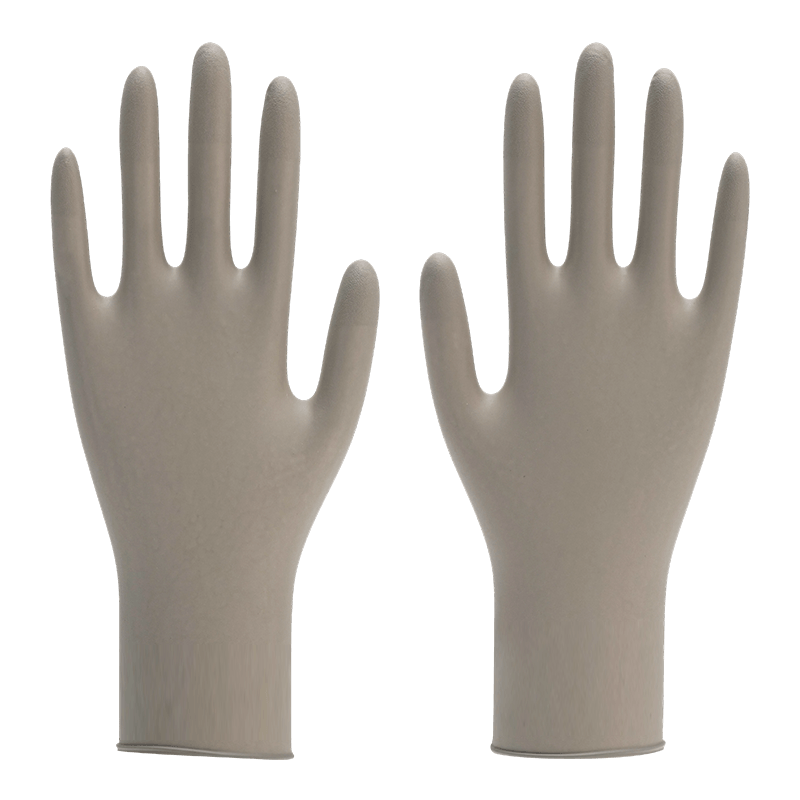 Wholesale 12 inch L Industrial Fingertip-Textured Nitrile Gloves Factory, SuppliJiangsu Complete Sincerity Medical New Materials Co., Ltd. is China wholesale 12 inch L Industrial Fingertip-Textured Nitrile Gloves fact...View Product →
Powdered vs. powder-free
Powdered gloves carry a cornstarch coating that makes them easier to slip on and off. Powder-free gloves are chlorinated or given a polymer coating to achieve the same easy donning without releasing starch into the environment. Powder-free is generally preferred in food preparation and medical settings, where powder can become a contamination issue. A food-grade powder-free glove with a 9-inch length is a frequent specification for processing lines: 9-inch L food-grade powder-free nitrile gloves.
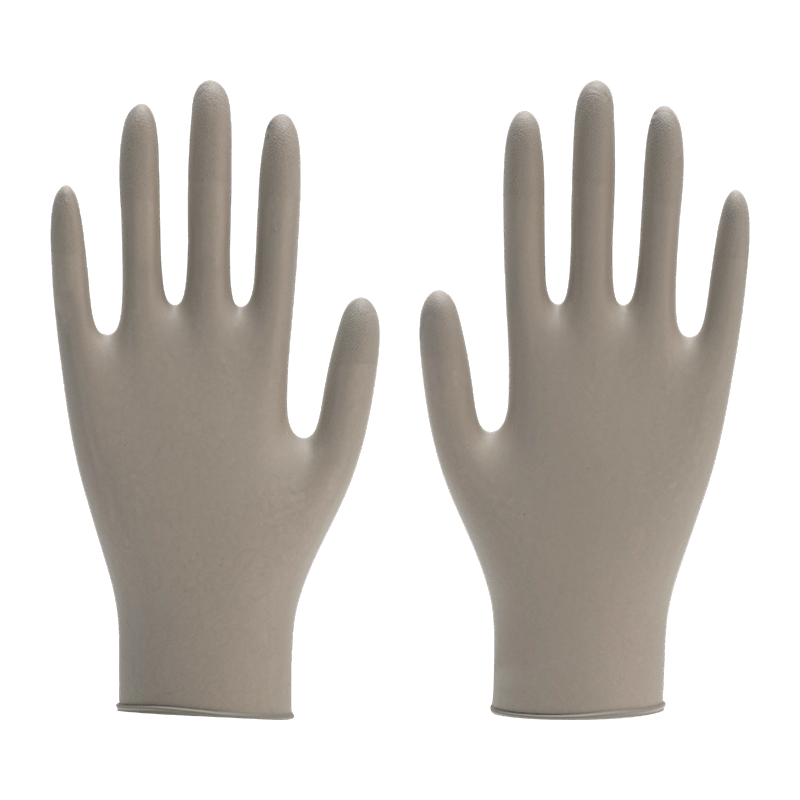 Wholesale 9 inch L Food-Grade Powder-Free Nitrile Gloves Factory, Suppliers - JiJiangsu Complete Sincerity Medical New Materials Co., Ltd. is China wholesale 9 inch L Food-Grade Powder-Free Nitrile Gloves factory and ...View Product →
9-inch vs. 12-inch
Length is a selection between coverage and dexterity. A 9-inch glove covers the wrist and is used for examination, handling, and most tasks. A 12-inch glove extends farther up the forearm and is used when splashes, chemicals, or contaminated surfaces reach beyond the wrist. Both lengths can be manufactured with the same texture and powder options.
Quality Control: Where Manufacturing Defects Are Caught
A glove is only as good as the inspection system behind it. After stripping, finished gloves pass through a combination of automated and sampling tests. Water leak tests and air inflation tests detect pinholes. Tensile and elongation tests assess the film's strength. Dimensional checks confirm length, thickness, and cuff width.
| Test | What it measures | Why it matters |
|---|---|---|
| Water leak test | Pinholes in the film | A direct measurement of barrier integrity |
| Tensile strength | Force needed to break the film | Predicts resistance to tearing during donning and work |
| Elongation at break | How far the film stretches before breaking | Shows flexibility and comfort in repeated movement |
| Dimensional sampling | Length, thickness, palm width | Confirms the glove fits its stated size and length |
Sampling is typically expressed through an Acceptable Quality Limit, or AQL. A lower AQL number means the manufacturer is allowing fewer defective units in a sample batch. Medical applications generally specify a tighter AQL than general-purpose applications. The AQL is not just a certificate on a wall; it comes from a repeatable inspection procedure on the production floor.
Consistency is another dimension of quality. Our facility runs full-process constant temperature control and uses extended conveyor chains in the oven zone to keep curing conditions uniform. That is why batch consistency is treated as a production discipline, not a promise made after testing.
What Buyers Should Ask a Nitrile Glove Manufacturer
When you source gloves by the hundreds of thousands, the manufacturing process determines whether you will receive predictable product or a continuous source of rejects. Ask for specifics, not vague promises.
- Ask for the AQL level and the sampling protocol used on your batch.
- Ask for dimensional data: length, thickness at palm and fingertip, and cuff width.
- Ask whether the glove is chlorinated or polymer-coated for powder-free donning.
- Ask about output stability. A line that can sustain 200 gloves per minute and production volumes above one million gloves per day can usually keep batch chemistry stable over long runs.
- Ask how the supplier handles compounding changes between orders. NBR ratio shifts can change glove feel and chemical resistance even if the size and packaging stay the same.
Manufacturing quality is won on the line, not in the box. The next time you compare nitrile gloves, read the technical sheet with the production process in mind. If the supplier cannot explain how their gloves are made, the gloves are trying to tell you something.
Featured Products
Recommended Products
News
-
-
Few questions reach our team as often as this one: how long do nitrile gloves actually last? As a manufacturer of medical examination gloves, we speak with purchasing managers every week who want a c...
READ MORE -
Choosing the right nitrile glove size does not have to feel like guesswork. In our years of producing examination, industrial, food-grade, and biosafety nitrile gloves, we have seen many buyers ask t...
READ MORE -
Before you place a glove order, one question always comes up: how many nitrile gloves are in a case? It seems like a small detail, but the answer shapes your budget, your storage planning, and how of...
READ MORE
Get A Free
Custom Quote!
Custom Quote!

We are committed to providing integrated solutions for nitrile gloves and non-woven products.
Get a Quote
Disposable Gloves
Quick Links
E-mail
gatherlucky-sales5@nt-huifu.com
Call Us
+86-18012229099
+86-18012229096
+86-18012229099
AddressNo.7 Wenzhou Road,Economic Development Zone,Shuyang County,Suqian, Jiangsu Province, China, 223600
copyright © Jiangsu Complete Sincerity Medical New Materials Co.,Ltd. All rights reserved.
 Registration Number: 2021200 / 2021200
This website is intended for users outside of China